English
 русский
 Español
News
Home / News / Industry News / Metallic Yarn for Embroidery: Types, Machine Settings, and Bulk Buying Guide

Metallic Yarn for Embroidery: Types, Machine Settings, and Bulk Buying Guide
Nov 18,2026
How to Calculate Thread Size: Measure Pitch, Diameter, and TPI for Any Bolt
Nov 11,2026
What Is Silk Made Of? Fibroin, Sericin, and the Fiber Processing Explained
Nov 04,2026
Properties of Linen Fibre: A Complete Guide to Strength, Moisture and Care
Oct 28,2026
Dri-FIT Nike Material Explained: How Moisture-Wicking Fabric Technology Works
Oct 21,2026Metallic embroidery thread costs two to three times more than standard polyester embroidery thread, yet it is usually the first material to snap, fray, or skip stitches on a production machine. In a commercial embroidery shop, one broken metallic thread on a 12-head machine interrupts the entire run, ruins the panel being stitched, and adds a cost that no pattern design can recover. The cause is rarely the machine. It is almost always the type of metallic yarn for embroidery selected for the job and the machine settings used to run it.
Metallic yarn for embroidery is a composite product, not a coated wire. A polyester or nylon core carries the tensile load, while a metallized PET film, typically 0.3 to 1 mm wide, is wrapped around the core to create the metallic appearance. When the film is too stiff, the thread snaps at the needle eye. When the core is too fine, the film shreds under tension. Every practical decision in this article follows from those two failure modes.
A metallic yarn for embroidery must survive several hundred needle penetrations per minute, so its design priorities are abrasion resistance, uniform diameter, and low friction, in that order.
Knitting-grade metallic yarn is intentionally soft and loosely twisted for hand feel. That same softness makes it unsuitable for machine embroidery, where the thread passes through the needle eye, the tension discs, and the fabric at high speed. An embroidery-grade metallic yarn carries a tighter twist, a smoother film surface, and a consistent diameter along the length of the cone. The tight twist keeps the film locked around the core so the needle does not separate the two layers.
Manufacturers classify metallic yarn with a short code, and that code tells you which applications the thread can handle before you mount it on the machine. Four codes cover most commercial metallic yarn for embroidery and decorative stitching: M, MH, MS, and MX. They differ in film-to-core ratio, twist density, and surface treatment, and those differences show up directly in how the thread behaves on a multi-head machine.
| Code | Construction | Key behavior | Embroidery fit |
| M type | Metallized PET film over a polyester core | Maximum shine, higher friction | Light decorative stitching |
| MH type | Reinforced film with extra twist density | Stronger and stiffer, lower flexibility | Weaving and braiding |
| MS type | Embroidery-optimized with smooth surface finish | Low friction, stable at high speed | Machine embroidery |
| MX type | Stability-enhanced polymer blend | Balanced strength and flexibility | General embroidery |
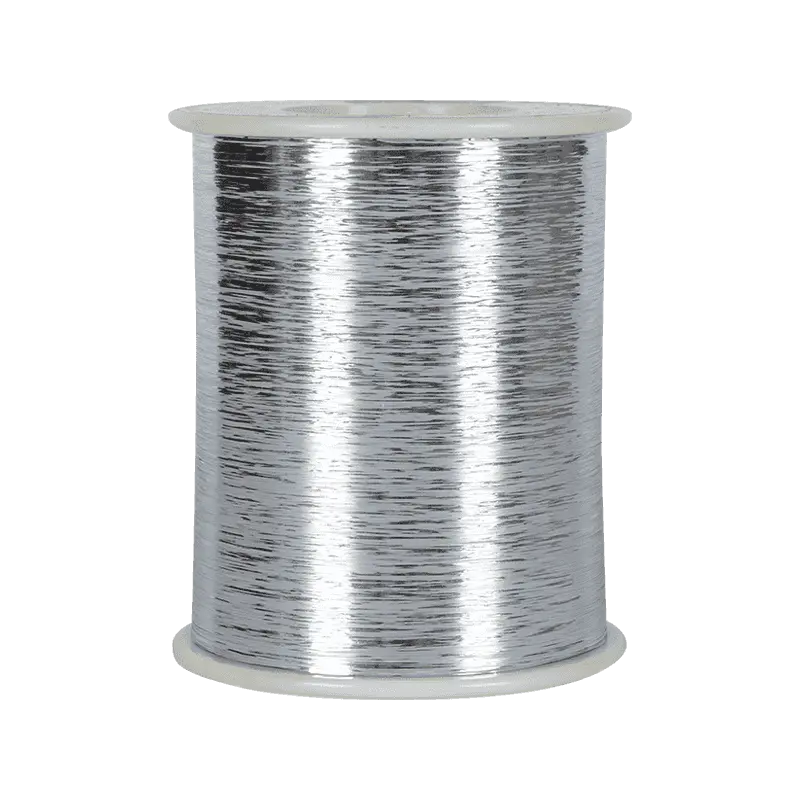
M-type metallic yarn delivers the strongest mirror shine because the metallized film dominates the cross-section. That same ratio makes it more sensitive to tension and more prone to edge fraying at high speed. Use it for decorative stitching, couching, and designs that need a striking reflective surface.
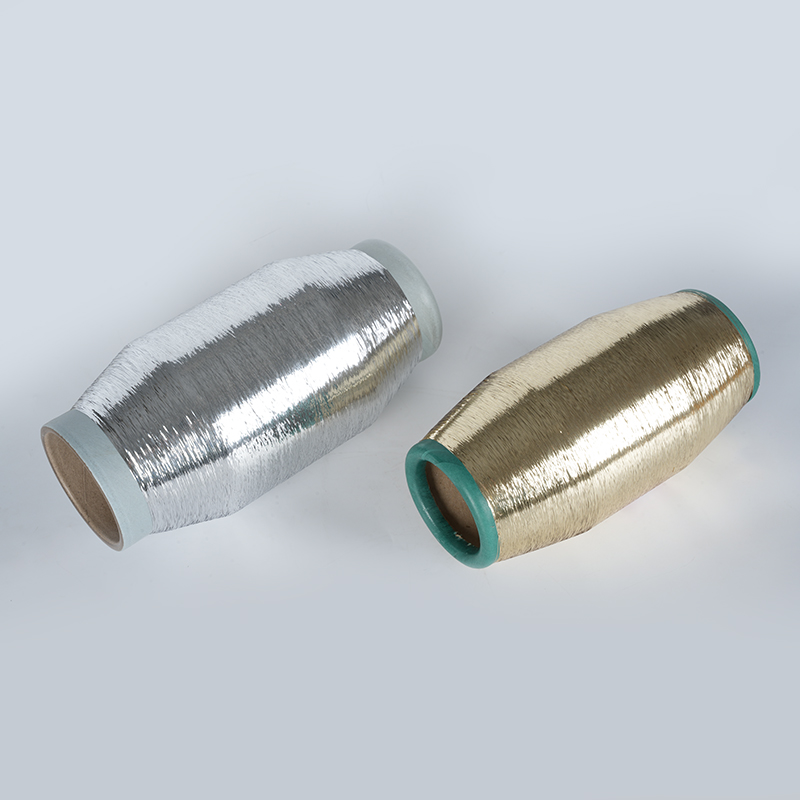 M-Type Metallic Yarn for High-Shine Decorative UseThis M-type yarn offers the strongest mirror shine among the metallic options, making it ideal for decorative stitching and couching where a striking reflective surface is desired.View Product →
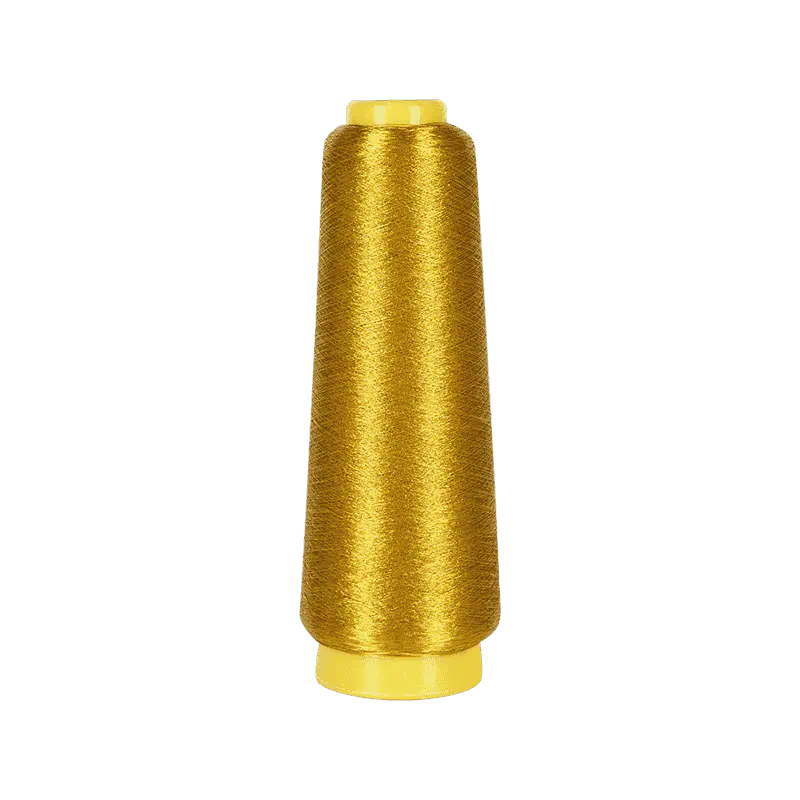
MH-type metallic yarn uses reinforced film with a higher twist density. It is stronger but stiffer, which makes it a better fit for weaving and braiding than for embroidery, where the thread must bend around the needle eye thousands of times.
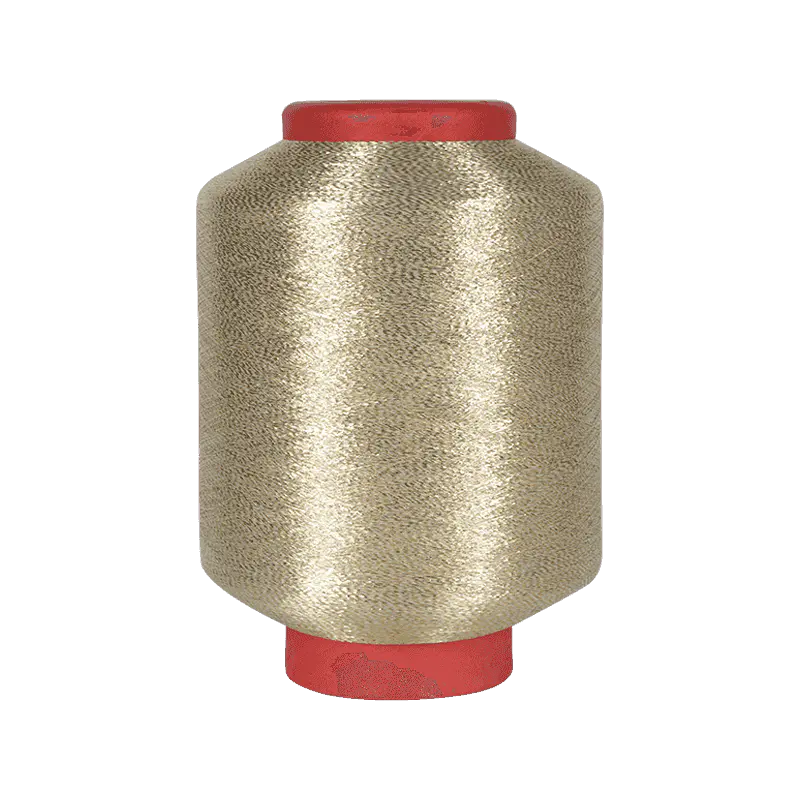
MS-type metallic yarn is formulated specifically for machine embroidery. The surface is smoothed to reduce friction in the needle eye and tension discs, and the twist is set to stay closed while the needle rises and falls. For embroidery-only production, MS is the code to specify.
 MS-Type Metallic Embroidery Thread with Smoothed SurfaceFormulated specifically for machine embroidery, this MS-type yarn reduces friction in the needle eye and tension discs, helping prevent breakage during high-speed stitching.View Product →
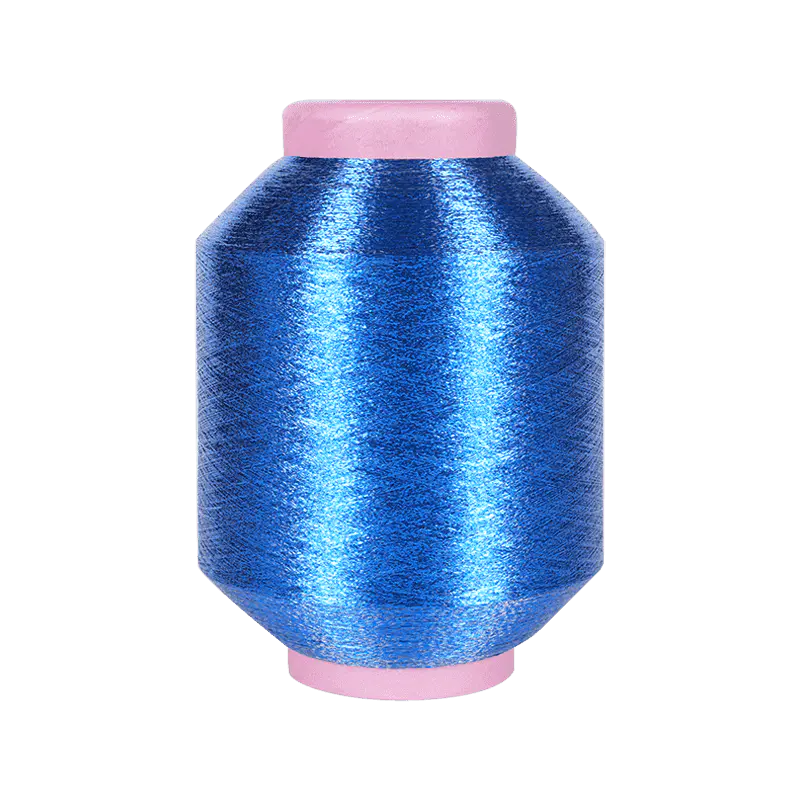
MX-type metallic yarn blends a stability-enhanced polymer with the metallic film, producing a balanced thread that is more forgiving than M-type on mixed fabrics. It suits general embroidery, ornamental seams, and designs that alternate metallic and standard polyester sections on the same machine.
MX-Type Metallic Yarn with Stability-Enhanced PolymerBlending a stability-enhanced polymer with metallic film, this MX-type yarn is more forgiving on mixed fabrics, making it suitable for general embroidery and ornamental seams.View Product →
Run metallic embroidery thread at 500 to 700 rpm with the top tension reduced by 10 to 15 percent and a fresh 75/11 needle, and most breakage problems disappear before they cost you a panel.
Metallic thread fails at specific points: the needle eye, the tension discs, and the take-up lever. Each failure point has a known fix. Work through the settings in this order, because tension and speed interact.
When you order metallic yarn for embroidery in bulk, specify the core material, film width tolerance, twist range, color fastness grades, and the certification standard that each delivery must meet.
Retail spools hide most of these parameters. Bulk orders should not. The six points below separate a reliable supply agreement from a batch of cones that looks right and behaves badly.
JinDun Textile Co., Ltd. (浙江仰世纺织有限公司) has produced metallic yarn since 2010 and operates a dedicated metallic yarn factory with automated production lines. The company supplies M, MH, MS, and MX types with Oeko-Tex and GRS certified production, and its in-house engineers support custom film width, twist, and dye-lot matching for bulk orders. Discuss the technical requirements with the sourcing team before the sample stage, so machine settings and yarn construction are aligned from the first trial. Contact the sourcing team for order-specific specifications.
Yes, when the core is polyester and the film is bonded correctly. Wash at 30 degrees Celsius in a mesh bag, avoid chlorine bleach, and iron on the reverse side at low temperature. Test a finished swatch before approving the production wash procedure.
Use a 75/11 or 80/12 embroidery needle with a large polished eye. Metallic film wears the eye faster than standard thread, so replace the needle after roughly eight hours of metallic stitching.
The usual causes, in order of frequency, are excessive top tension, machine speed above the yarn type limit, a worn or wrong-size needle, and using a knitting-grade metallic yarn in an embroidery machine. Correct the settings before changing the thread supplier.
MS-type metallic yarn is optimized for machine embroidery with a smoother surface and tighter twist that keep it stable at higher speeds. MX-type uses a stability-enhanced polymer blend and sits between M and MS in both shine and handling, which makes it a better choice for mixed embroidery runs.
Your email address will not be published. Required fields are marked *